Policy guides
Practical articles and templates for policy design, advocacy strategy, communication, implementation, and evaluation.
Resources
Explore practical policy guides, core public policy concepts, and frameworks for designing, influencing, and implementing public policy.
Catalogue
Practical articles and templates for policy design, advocacy strategy, communication, implementation, and evaluation.
A structured reference guide to one hundred core ideas in public policy, with concise definitions and academic references.
Analytical models and field-tested frameworks for diagnosing policy problems, mapping actors, and moving reforms forward.
Policy concepts
A structured resource for policy entrepreneurs, civil servants, policy advisors, NGO leaders, and change-makers. Each concept includes a concise definition and key academic references, adapted from the attached source document.
Section 1
Public policy is the authoritative pattern of governmental decisions, rules, spending and non-decisions directed at public problems. Classic definitions stress that what governments decline to do can be as consequential as what they do.
The policy cycle is a heuristic that divides policy into recurring stages such as agenda setting, formulation, adoption, implementation and evaluation. It is useful for organising inquiry and professional work, but it should not be mistaken for a literal description of all policy processes.
Agenda setting studies how some issues gain official attention while others remain latent. Focusing events are sudden, harmful and usually rare occurrences that accelerate attention, mobilisation and venue change.
Policy windows are brief opportunities for action when problem, policy and politics streams couple. In the multiple streams framework, entrepreneurs exploit these openings to move proposals onto the decision agenda.
Punctuated equilibrium argues that policy change is usually incremental because institutions filter attention, but occasionally large punctuations occur when issues are redefined or decision venues shift. It is especially useful for explaining long stretches of stability interrupted by abrupt change.
The advocacy coalition framework views policy subsystems as populated by coalitions of actors who share deep beliefs and compete over policy over long periods. Change commonly arises through learning, shocks, negotiated agreement or shifts in governing coalitions.
Policy paradigms are overarching cognitive frameworks that define legitimate goals, causal assumptions and appropriate instruments within a sector. Paradigm change is deeper than routine adjustment because it alters the terms of policy debate itself.
Policy learning denotes durable updates in beliefs, strategies or instrument choices prompted by experience, evaluation or comparison. It may be instrumental, social or political in character.
Policy entrepreneurs invest time, reputation or resources to couple problems, solutions and politics. They matter most when ambiguity is high and opportunities are fleeting.
Framing highlights some aspects of reality while downplaying others, thereby shaping how problems, causes and remedies are understood. Frame conflicts are often central to seemingly intractable policy disputes.
The narrative policy framework studies how policy stories use setting, characters, plot and morals to structure persuasion and coalition-building. It sharpens framing analysis by specifying narrative elements that can be compared empirically.
Policymakers do not optimise with full information; they satisfice under limits of attention, cognition and time. The concept underpins much modern work on agenda setting, organisational decision and incremental change.
Under uncertainty, decision-makers rely on mental shortcuts that can be efficient but also generate systematic errors such as availability, representativeness and anchoring. For policy analysts, the concept explains why judgment often diverges from formal rationality.
Behavioural public policy applies empirically grounded insights about choice architecture, cognition, norms and motivation to public problems. It is broader than nudge because it also includes boosts, incentives, communication and institutional design.
A nudge steers choices predictably without forbidding options or materially changing incentives. It is a specific choice-architecture tool, not a synonym for behavioural policy as a whole.
Historical institutionalism explains outcomes through temporally sequenced interactions among institutions, power and critical junctures. It emphasises how early choices structure later possibilities.
Rational choice institutionalism treats institutions as incentive structures that shape strategic behaviour under interdependence. It is strongest where delegation, contracts, veto points and collective-action problems are central.
Sociological institutionalism emphasises norms, scripts, identities and cultural legitimacy rather than only incentives. Policies persist not just because they are efficient, but because they become taken-for-granted and symbolically appropriate.
Path dependence means that early institutional or policy choices generate increasing returns, feedbacks and switching costs that make reversal difficult. It helps explain stickiness even when better alternatives later become available.
Public goods are non-rival and non-excludable, so markets tend to underprovide them because beneficiaries cannot easily be excluded from consumption. The concept is foundational for understanding why collective provision and taxation exist.
Section 2
Externalities are costs or benefits imposed on third parties outside market transactions. They justify taxes, subsidies, regulation and property-rights solutions.
Collective action problems arise when individually rational choices undermine jointly desired outcomes. Free-riding, coordination failures and trust deficits are classic mechanisms.
Common-pool resources are rival but difficult to exclude users from, such as fisheries, forests or groundwater. They differ from public goods because overuse, not underconsumption, is the central problem.
These are institutional features recurrent in long-enduring self-governing commons, including clear boundaries, monitoring, graduated sanctions and conflict-resolution mechanisms. They are not a universal recipe, but a diagnostic starting point.
Principal–agent theory analyses delegation under asymmetric information and divergent preferences. In policy, it illuminates problems of control between voters and politicians, ministers and bureaucrats, or governments and contractors.
Institutions and contracts are shaped by the costs of searching, bargaining, monitoring and enforcing agreements. Policy analysts use transaction-cost logic to compare direct provision, markets, contracting and hybrid arrangements.
Public choice applies economic reasoning to political behaviour, treating voters, politicians and bureaucrats as strategic actors with incentives of their own. It is a powerful corrective to naïve public-interest models, though often criticised for reductionism.
Rent-seeking occurs when actors devote resources to securing privileged advantages through policy rather than creating productive value. It typically produces deadweight loss and entrenches insider interests.
Capture occurs when regulators become aligned with the industries or interests they are meant to oversee. Capture can be material, cognitive, social or institutional, not just overtly corrupt.
Governance modes are the basic coordinating logics through which collective action is organised, classically hierarchy, market and network. Most real policy regimes are hybrids rather than pure types.
Policy networks are relatively stable patterns of exchange among public and private actors involved in a policy domain. They help explain access, influence, resource dependence and the boundaries of policy subsystems.
Network governance refers to steering through interdependent organisations rather than command alone. It focuses on coordination, trust, brokerage and rules for jointly managing shared problems.
Collaborative governance is a structured process in which public agencies and non-state stakeholders jointly deliberate and act on public issues. Its distinctive features are shared forums, joint decision processes and cross-boundary problem solving.
Co-production describes the joint creation of public outcomes by service professionals and users or communities. It shifts analysis from government delivering to government enabling and partnering.
Policy co-creation extends participation upstream into problem definition, design and experimentation, not only service delivery. It emphasises iterative problem-solving with citizens, users and front-line actors.
Deliberative democracy values reason-giving, inclusion and reflection in collective decision-making; citizen assemblies are one institutional form that operationalises those ideals through sortition and structured deliberation. The assembly is therefore an instrument within a broader democratic theory.
Participatory budgeting gives citizens a direct role in debating and allocating parts of public budgets. It is both a democratic innovation and a practical tool for legitimacy, learning and local accountability.
Interest groups are organised actors seeking to influence public decisions without themselves seeking public office. The concept is central for analysing pluralism, unequal access and issue representation.
Lobbying is the strategic provision of information, pressure and political support to decision-makers by organised interests. Modern research treats lobbying less as simple vote-buying than as subsidy, signalling and agenda work.
Media shape policy through agenda setting, framing, amplification and feedback from the public sphere. Their influence is strongest when policymakers are uncertain, audiences are attentive and issues are symbolically salient.
Section 3
Intergovernmental relations concerns the formal and informal interactions among central, regional and local governments. It matters because implementation, finance and accountability are often split across levels.
Decentralisation redistributes authority, finance or administration away from the centre. It can improve fit, accountability and experimentation, but it can also widen territorial inequality or blur responsibility.
Fiscal federalism studies the assignment of taxing, spending and borrowing powers across levels of government. It asks which functions are best centralised, decentralised or shared.
Policy diffusion occurs when choices in one jurisdiction alter the probability of adoption elsewhere through learning, imitation, competition, coercion or emulation. The key idea is interdependence among adopters.
Policy transfer is the more purposive process of borrowing ideas, institutions or instruments from another place or time. Unlike diffusion, transfer foregrounds agency, lesson-drawing and adaptation.
Street-level bureaucracy refers to front-line officials whose discretionary decisions effectively make policy in practice. Discretion is not a residual detail; it is a core mechanism through which formal rules are interpreted under pressure.
The implementation gap is the difference between policy as designed and policy as delivered or experienced. It can stem from ambiguous goals, weak coordination, insufficient resources, resistance or local adaptation.
Policy capacity is the set of analytical, operational and political competences that enable governments to formulate, implement and adapt policy effectively. It exists at individual, organisational and systemic levels.
Policy advisory systems are the institutional arrangements through which governments obtain and filter advice from civil servants, academics, think tanks, consultants and other experts. They shape what evidence is heard and how it is translated into actionable recommendations.
Legitimacy is the belief that authority is appropriate and ought to be complied with. In policy, legitimacy may derive from procedure, performance, legality, fairness or shared norms.
Accountability is the obligation to explain and justify conduct to a forum that can question and sanction. Public policy experts distinguish political, administrative, legal, professional and social forms of accountability.
Transparency is the availability and usability of information about decisions, processes and performance. It can support accountability and trust, but only when information is timely, intelligible and institutionally actionable.
Corruption is the misuse of public office or entrusted power for private gain. It degrades capability, distorts allocation, undermines legitimacy and changes how rules are actually used.
Public value focuses on what is collectively valuable to the public, not only efficiency or preference satisfaction. It asks managers and policymakers to align authorising support, operational capacity and socially valued outcomes.
Social equity concerns fair access, fair treatment and fair outcomes across social groups, especially for historically disadvantaged populations. It pushes policy analysis beyond average efficiency to distributional and procedural justice.
Distributive justice asks how benefits and burdens ought to be allocated across persons and groups. In policy, it structures debates on taxation, welfare, climate burdens and service prioritisation.
Ethics in policy addresses the moral standards that should govern public decisions, roles and administrative conduct. It covers conflicts of interest, responsibility, due process, impartiality and the ethics of consequences.
A human rights-based approach treats policies and programmes as instruments for realising rights, clarifying state obligations and rights-holders’ claims. It directs attention to participation, non-discrimination, accountability and remedy.
Gender mainstreaming integrates a gender perspective into preparation, design, implementation, monitoring and evaluation rather than confining gender to a separate silo. It is therefore a process strategy, not a single programme.
Intersectionality analyses how multiple axes of power and disadvantage, such as gender, race, class, disability or migration status, interact rather than simply add up. For policy, it warns against one-size-fits-all categories.
Section 4
This cluster sits closest to day-to-day policy practice. The Green Book defines appraisal as the assessment of costs, benefits and risks across options; the Magenta Book places evaluation across scoping, design, conduct, use and dissemination, and urges analysts to build evaluation into interventions from the earliest stages; and the Cochrane Handbook’s current structure makes explicit why systematic reviews, meta-analyses and non-randomised evidence are distinct but connected methods. [4]
Policy design is the deliberate matching of goals, targets and tools to a problem context. It links substantive choices about what government does with procedural choices about who is involved and how.
Policy instruments are the concrete levers through which policy acts, such as regulation, taxation, spending, information or direct provision. Instrument choice matters because tools have different behavioural logics, administrative burdens and political effects.
Policy mixes are portfolios of instruments whose combined effects may be complementary, contradictory or redundant. Analysis therefore looks not only at single tools but also at sequencing, consistency and coherence across tools.
Regulatory impact assessment is a structured ex ante appraisal of likely effects, alternatives and implementation consequences of proposed regulation. At its best it improves problem definition, option comparison and transparency; at its worst it becomes a ritual checklist.
Cost–benefit analysis monetises major costs and benefits to compare options on a common scale. It is most useful when impacts can be systematically valued, but it is often contested where distribution, rights or non-market values dominate.
Cost-effectiveness analysis compares the cost of achieving a given unit of outcome when monetising benefits is difficult or undesirable. It is especially important in health, education and environmental policy.
Stakeholder analysis identifies who affects, is affected by, or can block a policy, and maps their interests, resources and legitimacy. It is a diagnostic tool for feasibility, participation and implementation risk.
Evidence-based policy holds that decisions should be informed by systematically gathered and critically appraised evidence rather than anecdote alone. In practice, experts usually work with evidence-informed policy because evidence competes with values, institutions and politics.
Evidence synthesis integrates findings across multiple studies or data sources to support cumulative judgment. It is the umbrella category under which systematic reviews, meta-analysis and realist synthesis sit.
A systematic review uses transparent, replicable procedures to identify, appraise and synthesise relevant studies for a defined question. Its value lies as much in reducing selection bias as in summarising findings.
Meta-analysis statistically pools or compares quantitative study results to estimate overall effects and heterogeneity. It is a technique within, not a synonym for, systematic review.
Knowledge translation concerns the movement of research into policy and practice through brokering, adaptation, communication and implementation support. It recognises that evidence use is an active social process, not simple transmission.
The research–policy interface is the institutional boundary across which evidence, expertise and political judgment interact. It includes timing, incentives, advisory arrangements and the different logics of academia and government.
Randomised controlled trials identify causal effects by randomly assigning units to treatment and control conditions. They are powerful for internal validity, but their external validity and ethical fit depend on context.
Quasi-experimental methods infer causal effects without random assignment by exploiting natural experiments, discontinuities, timing differences or matched comparisons. They are indispensable where policy cannot be randomised.
Policy modelling represents dynamic or strategic relationships formally, whether through simulation, system dynamics, microsimulation or agent-based models. It is especially useful for exploring scenarios, feedbacks and trade-offs under uncertainty.
Systems thinking views policy problems as interconnected wholes characterised by feedback, delay, non-linearity and unintended consequences. It is particularly valuable for “wicked” problems where isolated interventions backfire.
Complexity theory emphasises emergence, adaptation, non-linearity and limited predictability in social systems. In policy, it warns against assuming simple causality or full central control.
Experimental governance uses decentralised trialling, feedback and revision to govern under uncertainty, often with framework goals and local adaptation. It treats learning and iterative problem-solving as core design principles.
Indicators are the metrics used to represent progress or conditions; monitoring is the routine collection and interpretation of those metrics over time. Together they support steering and accountability, but poorly chosen indicators can distort behaviour.
Section 5
The final cluster shows why modern public policy expertise cannot stop at technique. WHO’s Health in All Policies framework defines policy coherence for health and improves accountability for health impacts across all levels of policymaking; EIGE defines gender mainstreaming as integration across preparation, design, implementation, monitoring and evaluation; the IPCC synthesis stresses the interdependence of climate, ecosystems, human well-being and sustainable development; and OECD and UNESCO AI frameworks place human rights, transparency, accountability and sustainability at the centre of digital governance. [5]
Performance management uses targets, measures and review routines to steer organisations toward desired outputs and outcomes. It goes beyond measurement by linking information to incentives, learning or corrective action.
Policy evaluation types answer different questions: ex ante appraisal asks what may happen; process evaluation asks how delivery worked; impact evaluation asks what difference the intervention made; and ex post evaluation appraises longer-term value and lessons. Distinguishing types prevents the common mistake of using one design to answer all questions.
Privatisation shifts ownership, financing or provision from the public to the private sector. It should be analysed not as a synonym for efficiency, but as a choice about incentives, control and public risk.
Public–private partnerships are long-term contractual arrangements that bundle risk, finance or management across sectors to deliver infrastructure or services. Their appeal lies in lifecycle integration, but much depends on contract design and state capacity.
Public procurement is the process through which governments purchase goods, works and services. It is no longer viewed only as back-office administration, but also as a policy instrument for innovation, sustainability and social value.
Public finance studies how governments raise, allocate and stabilise resources; budgeting translates those choices into annual or medium-term decisions. Budgets are therefore both technical resource plans and political statements of priority.
Taxation is the compulsory raising of public revenue, but analytically it is also about incidence, efficiency, equity and state capacity. Tax design shapes behaviour and distributive outcomes as much as revenue.
Sustainability means meeting present needs without undermining the capacity of future generations to meet theirs. In policy analysis it requires integrating environmental, social and economic consequences across long time horizons.
Risk regulation governs activities that may generate harm under uncertainty, often under conditions of low trust and contested expertise. It requires choices about acceptable risk, burden of proof, precaution and distribution of responsibility.
The precautionary principle holds that lack of full scientific certainty should not by itself justify postponing protective action where serious or irreversible harm is plausible. Its practical difficulty lies in specifying thresholds, evidence standards and proportionality.
Climate policy includes mitigation, adaptation, finance and just-transition measures to manage greenhouse-gas emissions and climate risks. It is a paradigmatic cross-sector field because energy, land use, transport, industry and welfare all intersect within it.
Health policy concerns the governance of health systems, public health measures and the social determinants of health. It increasingly stresses whole-of-government coordination rather than treating health as a sectoral silo.
Education policy concerns how states govern curriculum, standards, finance, access, accountability and the organisation of learning. It is especially sensitive to implementation because classroom practice mediates formal reform.
Welfare state regime theory classifies affluent democracies by characteristic patterns of decommodification, stratification and state-family-market relations. It remains a core comparative lens despite many critiques and refinements.
Social policy instruments include cash transfers, social insurance, tax expenditures, in-kind services, care policies and activation measures. The crucial analytical question is not only generosity, but how instruments allocate risk, stigma and discretion.
Digital government redesigns state capacity, services and decision processes around digital-by-design principles; open data releases reusable public datasets for transparency, innovation and accountability. The two concepts are related but distinct because a government can digitise internally without being open externally.
AI governance concerns the rules, institutions and oversight mechanisms for developing, procuring and using AI systems responsibly. Public-policy experts now treat issues such as accountability, transparency, fairness, privacy, safety and human rights as central design constraints, not afterthoughts.
Migration policy governs entry, residence, asylum, integration and citizenship, while also managing labour demand, security and rights commitments. It is a classically mixed-motive field in which economic, humanitarian and sovereignty logics collide.
Security policy concerns how states define, prioritise and manage threats to people, institutions and territory. Modern analysis distinguishes traditional defence concerns from broader economic, societal, environmental and human-security logics.
Crisis management covers prevention, preparedness, response and recovery for acute disruptions; resilience denotes the capacity of systems to absorb shocks, adapt and continue functioning. They are complementary but not identical, because resilience also concerns learning and redesign between crises.
Policy frameworks
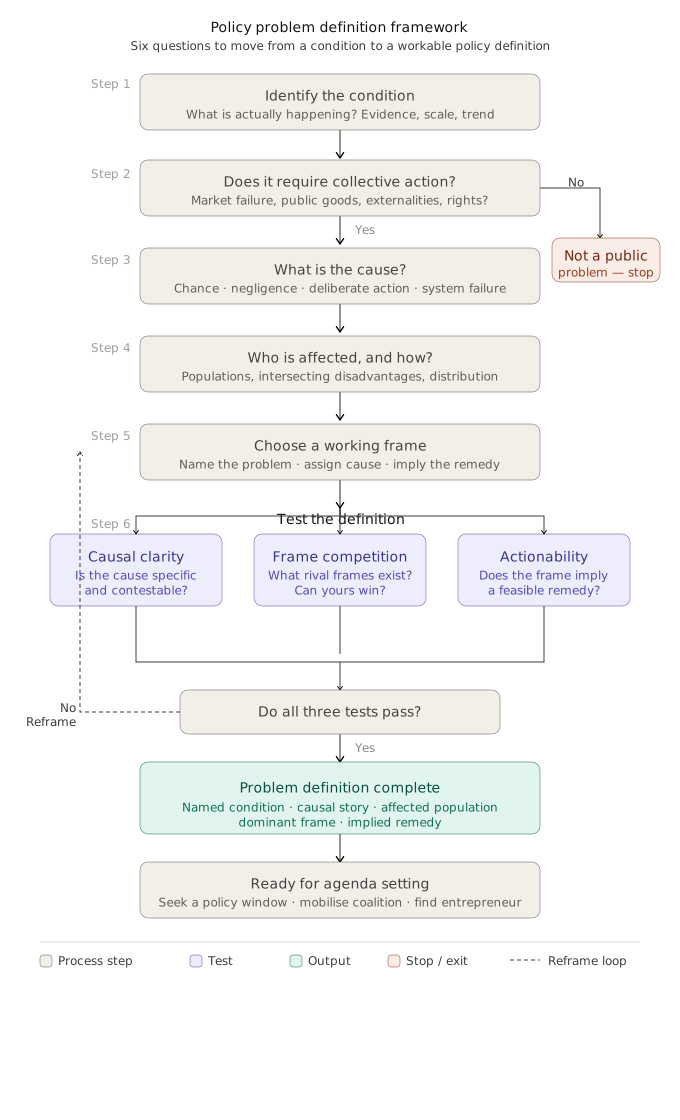
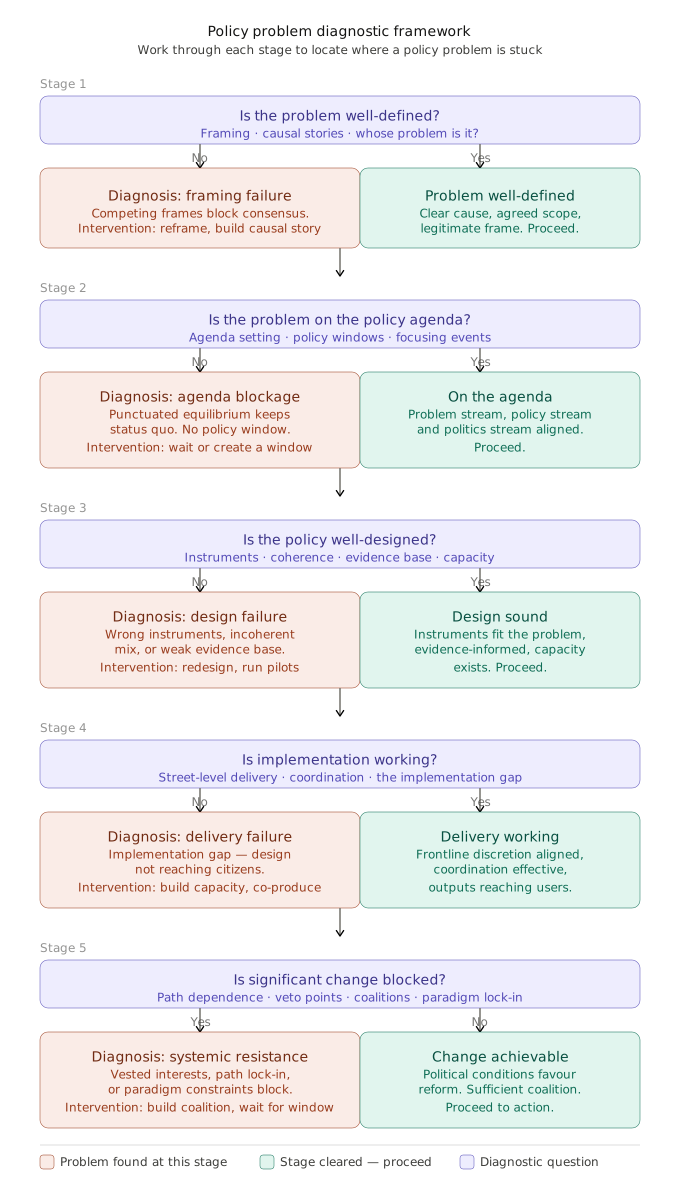
Practical visual frameworks for moving from broad public problems to sharper diagnosis, clearer definition, and more useful policy action.
Use this framework to examine symptoms, causes, affected groups, evidence, incentives, institutional constraints, and implementation barriers before proposing a solution.
Use this framework to turn diagnosis into a clear problem definition, including boundaries, stakeholders, causal claims, policy stakes, and the change you want to make possible.